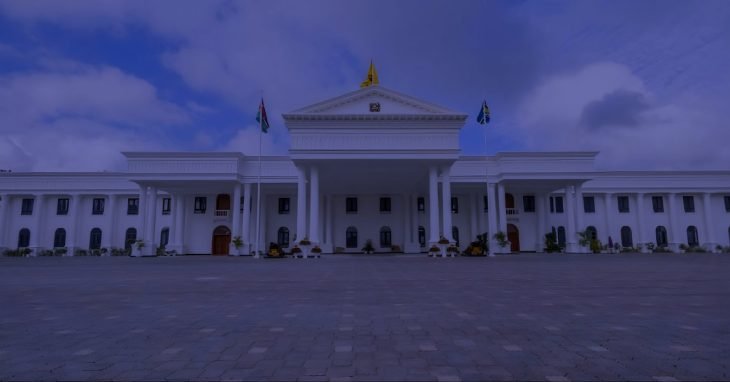
Few line items in Kenya’s national budget generate as much curiosity – and debate – as the Kenya State House budget. In pure fiscal terms, it represents a tiny fraction of the government’s total spending. Yet politically and symbolically, it sits at the very centre of the state.
The presidency is the most visible institution in the country. When questions arise about fiscal discipline, governance priorities, or the burden of taxation, the spotlight often falls first on State House. But the truth about the Kenya State House budget is more nuanced than the debate sometimes suggests. Whether it appears large or modest depends heavily on the lens through which it is examined: absolute cost, share of GDP, or cost per citizen. Each perspective tells a different story.
The Kenya State House Budget in Context
Recent Treasury estimates place the State House budget between KES8.6 billion and roughly KES17 billion, depending on supplementary allocations and operational adjustments. Officials have also requested around KES20 billion for the next financial year, citing expanded operations and the addition of more state lodges as contributors to the rising expenditure. Converted to international terms, this places annual presidential spending roughly in the range of $65 million to $130 million.
That figure alone sounds significant — but context is everything. Kenya’s total national budget now exceeds KES4 trillion, meaning the presidency accounts for 0.09% of government spending. Yet the debate rarely stops there.
What Other Countries Spend on their Executive Offices
When the Kenya State House budget is compared with executive office budgets in major developed economies, the results are intriguing. A few examples illustrate the point:
- The United States White House operational budget is roughly $60 million annually.
- The United Kingdom’s prime minister’s office at 10 Downing Street operates at about $25–30 million.
- Germany’s Federal Chancellery runs at roughly $45–50 million.
- France’s Élysée Palace, which supports a strong presidential system, costs around $110–120 million annually.
- Italy’s Presidency of the Council of Ministers has an administrative budget exceeding $200 million.
In simple dollar terms, Kenya’s presidency sits roughly in the middle of this range, comparable in scale to France or Japan depending on the year and exchange rate. But that comparison can easily mislead.
In many advanced economies, presidential costs are spread across several departments — defence, foreign affairs, intelligence, and national security. In Kenya, a larger portion of these functions is consolidated within the State House vote.
A Regional Comparison
Within Africa, comparisons are equally revealing. Among some of the continent’s more stable or economically progressive states:
- South Africa’s presidency operates with a budget of about $55–65 million.
- Ghana’s Office of the President is estimated at around $50–70 million.
- Rwanda’s presidency runs at roughly $35–45 million.
- Botswana’s Office of the President costs around $30–40 million.
- Mauritius, which splits executive authority between a president and prime minister, spends roughly $15–20 million on executive administration.
By comparison, the Kenya State House budget sits toward the upper end of presidential spending in Africa, though not dramatically outside the continental range.
When Scale Changes the Story
A more revealing perspective is to compare presidential spending relative to national economic output, the GDP. Large economies naturally dilute executive costs. For example, the United States economy, worth about $27 trillion, makes the $60 million White House budget almost statistically invisible. Germany’s $4.5 trillion economy produces a similar effect for the Chancellery. Kenya’s economy, by contrast, is roughly $110–120 billion.
When the Kenya State House budget is measured against GDP, it represents roughly 0.05–0.1% of the national economy. That places Kenya:
- Higher than advanced economies
- Comparable to many developing states
- Below some smaller African administrations where executive spending can exceed 0.2% of GDP
In other words, Kenya’s presidency appears expensive relative to wealthy nations, but fairly typical when compared with countries of similar economic scale.
The Per-Citizen Perspective
Another way to interpret the State House budget is to divide it across the population. With approximately 55 million citizens, the presidency costs each Kenyan roughly $1–$2 per year.
A few global comparisons offer perspective:
- United States: about $0.18 per citizen
- United Kingdom: roughly $0.40 per citizen
- Germany: about $0.60 per citizen
- South Africa: about $1 per citizen
- Botswana: over $10 per citizen
Kenya therefore falls somewhere in the middle of global executive spending per capita. Yet numbers alone do not capture public perception. In high-income countries, even a few dollars per citizen may feel negligible. In lower-income economies where many households face daily economic pressures, the symbolism of government spending can carry far greater weight.
The Geography of the Kenyan Presidency
Another factor rarely discussed in this debate is geography. Unlike many countries that operate from a single official residence, Kenya maintains multiple presidential residences and lodges across the country, including in Nairobi, Mombasa, Nakuru, Sagana, Kisumu, and Eldoret.
Maintaining and securing these facilities inevitably increases administrative costs. At the same time, they serve a practical purpose: enabling the presidency to operate across different regions of the country. In a geographically diverse nation, the presidency functions not just as an office but as a mobile national institution.
Where Kenya Ranks
Taking these different comparisons together produces an interesting picture. Globally, Kenya does not rank among the highest presidential office budgets in absolute terms. It sits roughly mid-range compared with major developed economies. Within Africa, the Kenyan State House budget ranks among the higher presidential expenditures, though still within the broader continental pattern.
Relative to GDP, Kenya’s presidency is more expensive than those in advanced economies, but not unusually large for developing nations.
Optics and Trust are the Deeper Issue
Ultimately, debates about the State House budget are not purely about arithmetic. They are about trust and symbolism. When citizens face rising taxes, public debt, or economic uncertainty, they look first to the highest office in the land for signs of restraint.
The presidency therefore carries a unique burden. It must not only govern effectively — it must also be seen to embody the fiscal discipline expected of the nation. In that sense, the State House budget is more than an administrative figure. It is a reflection of how citizens perceive the relationship between power, responsibility, and public resources.
Viewed through the lens of national GDP, the Kenya State House budget is small. Viewed per citizen, it is modest. Viewed politically, it is enormous. And perhaps that tension explains why the debate continues. Because in modern democracies, the true cost of leadership is not measured only in shillings or dollars but in the confidence citizens place in those who hold power.