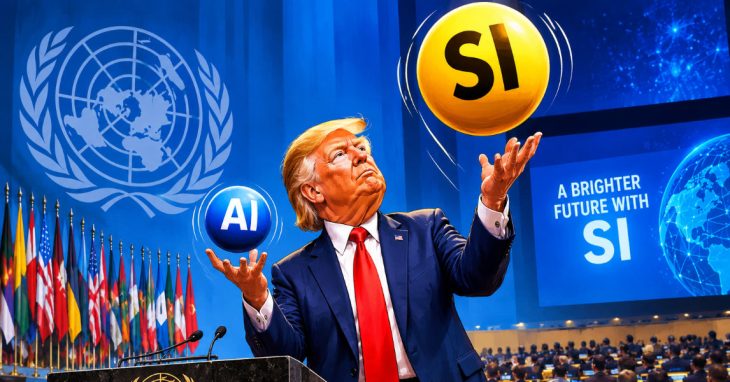
Trump told the UN that America will stop saying artificial intelligence. The clause that did it was attached to something larger, and the word he chose was already taken by the people he was rejecting.
What’s in a Name? That Which We Call Artificial Intelligence Could Also Be Super Intelligence
Donald Trump told the United Nations General Assembly on 22 September 2026 that the United States is retiring the term artificial intelligence. The sentence that did it is worth quoting whole, because the renaming is the smaller half of it. From the White House’s own release:
“The United States totally rejects any attempt to construct a globalist scheme of control for the Artificial Intelligence being spoken of so much now — hereinafter officially called ‘Super Intelligence.'”
Note the word “hereinafter.” That is the vocabulary of legal drafting, borrowed for a sentence that drafts nothing.
The Word Was Already Taken
Super intelligence is not vacant vocabulary waiting to be assigned. Nick Bostrom used it in a paper in 1997 and defined it in his 2014 book as “any intellect that greatly exceeds the cognitive performance of humans in virtually all domains of interest.” The term names a threshold above artificial general intelligence, which itself sits above anything running in production today.
The industry has built institutions on that precision. OpenAI named its superalignment programme in 2023 for the problem of aligning superintelligent systems specifically. Ilya Sutskever founded Safe Superintelligence Inc. in June 2024. Meta opened Superintelligence Labs in 2025. In every case the word carries a threshold, not a compliment.
Thirteen days before the UN speech, Evan Hubinger, who leads Anthropic’s Alignment Science team, wrote that his employer does “not yet have a plan to solve alignment for superintelligence.” He was describing a system nobody has built. Under the new usage he is also describing the model that answers your support tickets.
The Best Objection: Naming Here Was Never Honest
There is a strong case that all of this is a category error, and it deserves stating properly rather than brushing aside.
Artificial intelligence was never a careful description either. John McCarthy coined it in the summer of 1955, with Marvin Minsky, Nathaniel Rochester and Claude Shannon, to advertise a workshop at Dartmouth. His own account of why is unusually candid:
“One reason for inventing the term was to escape association with cybernetics. I wished to avoid having either to accept Norbert Wiener as a guru or having to argue with him.”
The field’s founding label was a positioning move against a rival, chosen loose enough that almost any automated system could wear it. Anyone defending the incumbent term as principled has to sit with that.
The difference is what each act was done to. McCarthy named an empty space and the meaning accumulated afterwards. Renaming AI super intelligence overwrites a term that already carries a specific technical threshold. The word’s current owners are the researchers warning that the threshold is dangerous.
What a Speech Cannot Reach
Artificial intelligence is a defined term in United States law, and no address changes it.
Title 15, section 9401(3) of the US Code carries the wording. An artificial intelligence system is “a machine-based system that can, for a given set of human-defined objectives, make predictions, recommendations or decisions influencing real or virtual environments.” Congress enacted that through Public Law 116-283 on 1 January 2021.
That definition has a provenance worth noticing. It was adopted almost verbatim from the OECD AI Principles, which the United States joined on 22 May 2019, represented by the National Telecommunications and Information Administration. The European Union’s own definition, in Article 3(1) of Regulation (EU) 2024/1689, descends from the same 2019 text.
So the operative American definition of artificial intelligence is a multilateral instrument that the United States helped negotiate, endorsed, and then wrote into statute. A speech rejecting globalist mechanisms over the word cannot touch the genuinely international artefact that gives the word its legal force.
As delivered, the ambition ran wider than the release. “From this point forward, all of United States documents, and hopefully the world’s will be changed to use the much more accurate term ‘super’ as opposed to artificial.” The executive branch can certainly change its own prose. It will have some work to do. One of its own executive orders, signed 11 December 2025, is titled “Ensuring a National Policy Framework for Artificial Intelligence.” That order directs a Department of Justice litigation task force against state AI laws. NIST carries the term in its document identifiers rather than merely its text, in AI 100-1 and AI 600-1. As of 22 September 2026 no executive order or agency memorandum implementing the new terminology has appeared.
The Committee They Voted Against
The “globalist mechanism” in that sentence is not hypothetical, and it has less power than the phrasing suggests.
The UN General Assembly created the Independent International Scientific Panel on AI by resolution A/RES/79/325 on 26 August 2025. Forty members were appointed on 12 February 2026. The panel is modelled on the IPCC and is explicitly non-regulatory. In the UN’s own description, it “does not set binding rules, approve AI systems, or impose standards on governments or companies.” It writes annual reports.
The United States voted against establishing it. Paraguay joined that vote, Ukraine abstained, and 117 member states voted in favour.
Its co-chairs are Maria Ressa and Yoshua Bengio. Bengio has spent years arguing that superintelligence is the thing to worry about. The administration has adopted his vocabulary and voted against his committee.
What This Means If You Have to Prove Compliance
Perhaps you maintain an AI governance register, a risk classification, or a vendor questionnaire. The practical position is stable. Your obligations still key off the statutory and regulatory definitions, not the press releases.
Nothing about renaming AI super intelligence alters what triggers a control. An EU AI Act risk tier attaches to an “AI system” under Article 3(1). A federal reporting duty attaches to the section 9401 definition. Contract language, export classifications and standards references point at those same terms. Suppose the executive branch switches its own prose without matching statute. The result is two vocabularies describing one set of obligations. That is a documentation problem rather than a legal one.
The thing to watch is narrow and falsifiable. Either an executive order or an OMB memorandum implements the change in defined terms, or it does not. Until one does, this is style guidance.
What Then?
The gap between what a name promises and what a definition controls is where most governance failures live, and this week offered an unusually clean example of it.
A president took the safety community’s word for the system nobody knows how to control. He applied it to everything already deployed. He did it in a sentence rejecting a scientific panel that has no authority to regulate anything, and one of whose co-chairs gave the word its weight in the first place.
Meanwhile the definition that actually determines who has to do what sits where it has since January 2021, imported from a body in Paris. Renaming AI super intelligence took one sentence. Amending section 9401 would take Congress.
Names move quickly. Obligations move at the speed of statute. Anyone whose job involves the second should be slow to react to the first.